Engagement at a Glance Snapshot
Who is the agency featured in this case study, and what did they come to Evan Cox Consulting (ECC) for?
This agency is a mission-focused nonprofit whose executive director spent roughly 70% of her time on fundraising. With a multi-year 7-figure grant expiring, she came to us looking for a plan to build new donor relationships, hand off key donor relationships to a new major gifts officer (MGO), and understand whether their donor data was healthy.
What did the data reveal that changed things for the agency?
About three-quarters of the way through the audit, we found that the agency’s donor lapsing wasn’t random. A significant share of lapsed donors had been giving to specific missionaries or countries the organization had since stopped serving. That led to a conversation with their executive director, and we helped them define a relationship tagging system for “mission-activated” and “mission-engaged.” Many mission agencies have donors who follow a person rather than the organization, so we worked with the executive director and her new MGO to build an engagement cadence to reactivate supporters through giving them a project or region they could joyfully support.
How much lapsed giving did the ECC team identify, and how was it segmented?
Using recency, frequency, and monetary (RFM) scoring, our team segmented the agency’s full lapsed-donor file by reactivation likelihood. Within a high-reactivation lens, that pointed to $859,000 in near-term recoverable giving.
What’s the core insight from this engagement?
Standard lapsed-donor win-back tactics assume the donor disengaged from the mission. The agency’s data showed many donors disengaged from a person, like a missionary or a country program that no longer existed. Their reactivation strategy had to reconnect donors to a comparable cause or leader instead of just asking them to come back.
What did ECC build for the agency?
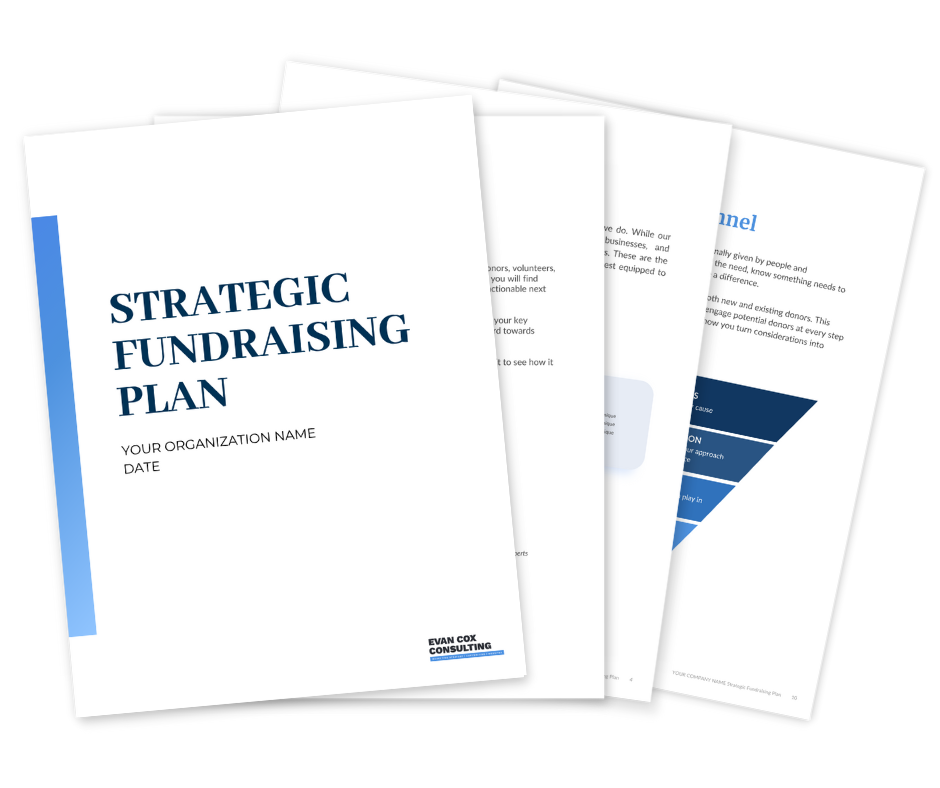
A full major gifts system: a donor reactivation cadence, a meeting framework for major gift conversations, an end-of-year campaign, a monthly giving program, a donor journey map, a major gifts playbook for transitioning relationships from the executive director to the new major gifts officer, and a leading/lagging KPI framework to track progress.
Note: We’ve anonymized this case study, including the organization’s name and their staff. We did this so we can share concrete numbers and strategy without compromising a client’s privacy.
A missions agency came to Evan Cox Consulting with a familiar problem for a lot of growing nonprofits: their executive director had become their fundraising department.
She was spending about 70% of her time on fundraising. That’s not unusual for a founder-led or ED-led nonprofit in its earlier stages, but it’s not sustainable either. She wanted a better picture of what was happening with their donors and a plan that didn’t depend entirely on her.
There was also a deadline attached. The agency had a $1.8 million grant spread across three years, and it was set to expire. That created urgency: they needed a plan to bring in new donors, and they needed to start handing off key donor relationships to their new major gifts hire, so their executive director wasn’t the only person carrying those relationships.
Going in, the goals were clear:
- Build a plan for attracting new donors
- Start moving key donor relationships off the executive director’s plate and onto their new hire’s
- Get a read on whether their donor data was healthy and moving in the right direction
That last one, the data health check, is where things got interesting. What started as a fairly standard fundraising audit ended up surfacing something about the agency’s donors that nobody on their team had put into words yet.
What Our Audit Found
Before getting into the big insight, it’s worth walking through what our fundraising audit found at the agency, because much of it was fixable things common at growing nonprofits.
Their CRM was underused
The agency used Virtuous, a solid donor management platform, but they weren’t using it the way it was built to be used. Instead of setting up recurring reports, someone was running one-off queries every time they needed information. Virtuous also has built-in automation for much of the manual data work their overseas team was doing by hand that could’ve been running in the background the whole time.
Their asks weren’t consistent
Looking through their direct mail history, our team noticed some strange patterns. Donors who had given $10,000 gifts in the past were being asked for $100 in a later appeal. They didn’t have a system to match the ask to the donor’s giving history, so people who could give significantly more got the same generic appeal as everyone else.
Their incentives were scattered
At one point, the agency gave away Apple AirPods to donors. Not a bad idea on its own, but it pointed to a bigger theme: their fundraising tactics were all over the map instead of following a consistent strategy.
There wasn’t a plan for the leadership handoff
The executive director wanted to reduce her fundraising hours, but there was no defined plan to bring a new major gifts hire fully up to speed, or a system for how relationships would move from her to them.
On their own, these are normal growing pains. However, once we started digging into the donor data, a bigger pattern started to show up, and that’s where the real story begins.
The Data Deep Dive
To understand what was happening with the agency’s donors, we pulled their giving history from Virtuous and laid it out simply: who gave, when, and how much.
The numbers weren’t great on the surface. Total donors, recurring donors, and retention were down, while donor lapsing was way up. That alone looked like a typical fundraising problem, but it wasn’t happening evenly. A clear bump in giving tied to the agency’s work in Lebanon, and donors seemed to be lapsing in clusters rather than gradually drifting away.
So our team lined the donor data up against what had been happening at the agency. Over the past couple of years, the organization had stopped serving in several countries, and several missionaries had left or moved on. When they compared that timeline to the lapsing data, it matched almost perfectly.
Donors weren’t leaving because they’d lost interest in the agency. They were leaving because the specific person or program they’d been supporting was no longer there.
The Fix: Mission-Activated vs. Mission-Engaged
Once we brought this pattern to the executive director, she said something that reframed the engagement: many of these donors weren’t giving to the agency but to a specific missionary.
She called it being “mission-activated” rather than “mission-engaged.”
- Mission-engaged donors are committed to the agency as an organization and its broader work.
- Mission-activated donors got involved because they knew a specific missionary. Their giving followed that relationship, so when the missionary left, the giving usually left too.
This isn’t unusual in support-raising. Donors follow missionaries from organization to organization all the time, switching their giving to keep supporting the same person doing the work somewhere new.
But it’s a problem if you don’t know it’s happening, because it changes what a win-back campaign should look like:
- You can’t ask someone to reconnect with an organization when what they cared about was a person or a place.
- You can offer them a new version of that same connection: a similar project, leader, or community they might care about just as much.
That’s where the reactivation language came from. Instead of a generic renewal ask, it became something more like:
“Would it bless your family to make it possible?”
This was an invitation, and a much better fit for donors who didn’t disengage from the mission, just from the person they used to follow.
Turning Insights Into a System
Knowing why donors were lapsing was one thing, but knowing who to reach out to first, and how much was at stake, was another.
To answer that, our team created a scoring model on the agency’s donor file based on recency, frequency, and monetary value. Basically, how recently someone gave, how often they’ve given, and how much. That let the team sort lapsed donors into tiers based on how likely they were to come back.
Here’s how the lapsed giving broke down:
- 13-18 months lapsed: 71 donors, $578,620 (the strongest reactivation candidates)
- 19-24 months lapsed: $280,000 (still a strong opportunity)
- 25-36 months lapsed: $2.1 million
- 37+ months lapsed: $8.3 million
Within the group most likely to respond to outreach, that added up to $859,000 in near-term reactivation potential. This was money that was sitting in the agency’s own donor history, just waiting on the right approach.
From there, we built out a practical model for how a major gifts officer should work these lists: which tier to prioritize, what the conversation should sound like, and how to connect a lapsed donor back to a cause or leader similar to the one they originally supported.
The Full Deliverable Set
After the insight was in hand, the audit turned into a full system the agency could run with. Here’s what we built for them:
- A donor reactivation cadence. Reconnecting lapsed donors to a similar cause, leader, or region instead of a generic “wait, come back!” appeal.
- A major gifts meeting framework. A simple structure to help their team run better donor conversations.
- An end-of-year campaign, built out and ready to run.
- A monthly giving program, aimed at doubling their number of monthly donors.
- A donor journey map, so the team can see where donors are at each stage of the relationship.
- A major gifts playbook. A proven plan for handing key donor relationships off from the executive director to their newer major gifts hire.
- A KPI framework to track both the day-to-day activity (leading indicators) and the results that activity should eventually produce (lagging indicators).
Put together, it gave the agency something they didn’t have before: a system that doesn’t live entirely in their executive director’s head.
The Results
By the end of this engagement, the agency had a number attached to a problem they hadn’t been able to name before, and a plan for what to do about it.
- $859,000 in lapsed giving identified as a near-term reactivation opportunity, based on donor data instead of guesswork.
- A tiered reactivation strategy, so outreach starts with the donors most likely to respond first,
- A named, understood pattern that changes how the agency talks to lapsed donors going forward.
- A KPI framework in place to track both activity (donor conversations, follow-up speed, CRM documentation) and results (revenue, retention, new major donors).
- A plan to move key donor relationships from the executive director to their new hire, with a goal of bringing the executive director’s time in fundraising down from 70% to 40-50%.
That last point might be the one that matters most. The agency got a plan that doesn’t depend entirely on one person to run it.
Our Best Advice
- When your lapsed-donor numbers don’t make sense, look at what changed in your programs
The agency’s lapsing wasn’t random, but it looked that way until we compared it against their program history. If your retention numbers are dropping and the usual fixes aren’t helping, check whether something changed on your end first, like a staff departure, a program ending, or a shift in who’s doing the asking.
- Not all lapsed giving is equally recoverable, so segment it before you create a reactivation plan
A donor who gave 14 months ago and a donor who gave four years ago aren’t the same kind of opportunity, and they shouldn’t get the same outreach. Sorting lapsed donors by recency before you develop a win-back strategy tells you where to spend your energy first.
- Let AI handle the scoring, not the strategy
AI was useful for crunching the agency’s donor data into something actionable. However, the real insight came from a conversation with someone who knew the organization. Data can tell you what’s happening, but it still takes a person to figure out why.
Links Worth Your Time
Want to go deeper on any of this? Here’s where to find more:
- Connect with us: Evan’s LinkedIn
- Download The One Afternoon Annual Report